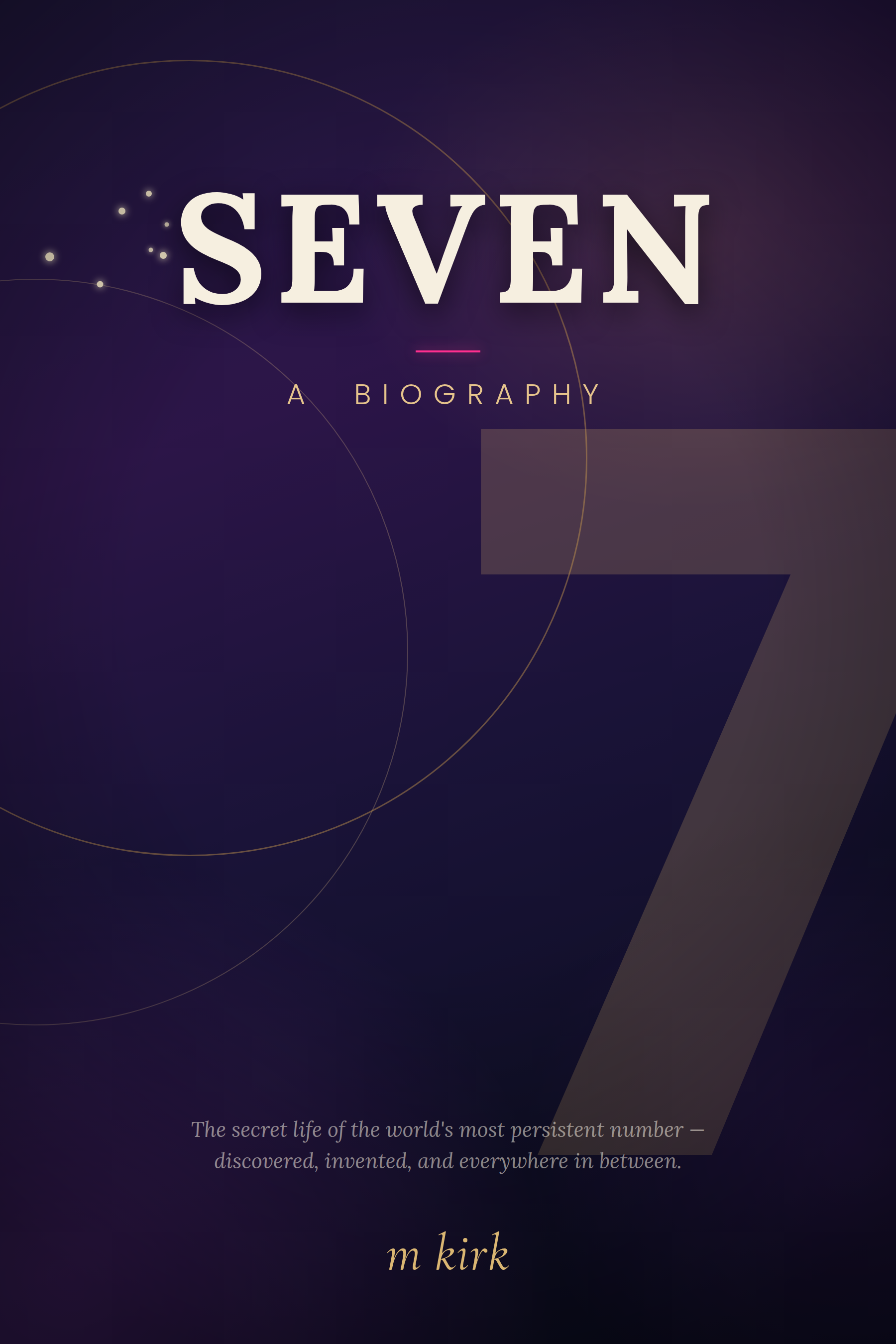
SEVEN
The secret life of a number
This is the biography of a number – born as tally marks on a 20,000-year-old bone, grown into the darling of prophets and lawgivers, aged into a jingle and a lucky charm.
[Title flag – the real cover art (2026-07-29) reads just "SEVEN – A Biography," no "Magnificent." But the About page's real bio prose calls it "The Magnificent Seven" in two places. Left both as they are rather than guess which is current – confirm and I'll make it consistent everywhere.]
About the Book
It follows Seven from its first appearance as tally marks on a 20,000-year-old bone through its stint as the darling of prophets and lawgivers, its middle age as the architect of cosmic order, and its late-career second act as a jingle and a lucky charm. The chapters map onto Shakespeare's seven ages of man, so Seven is born, goes to school, falls in love, fights, judges, ages, and fades into cultural echo – with a full cast of rival numbers weighing in along the way.
Three keeps things minimal. Eight organizes fun spreadsheets. Twelve never lets anyone forget how divisible it is.
Expect long, curious digressions that always land somewhere – a chapter on legal codes might start at a Babylonian treaty tablet and end at Newton deciding, on a whim, that the rainbow needed one more color. It reads like a curious, well-read friend explaining something at dinner, not a textbook.
Most books about numbers catalog their appearances – this one gives a single number a life story, with an arc, a personality, and something at stake. Underneath the humor sits one real question, asked again in every chapter and never quite answered: is Seven a pattern nature actually produces, or one the human mind insists on finding? The book sits with that tension instead of resolving it for you.
For readers of Bill Bryson's A Short History of Nearly Everything, Oliver Sacks, Alex Bellos, and Simon Winchester.

A Note from the Author
[Placeholder – Matt's note on Seven goes here: why a number, why this structure, what started it.]