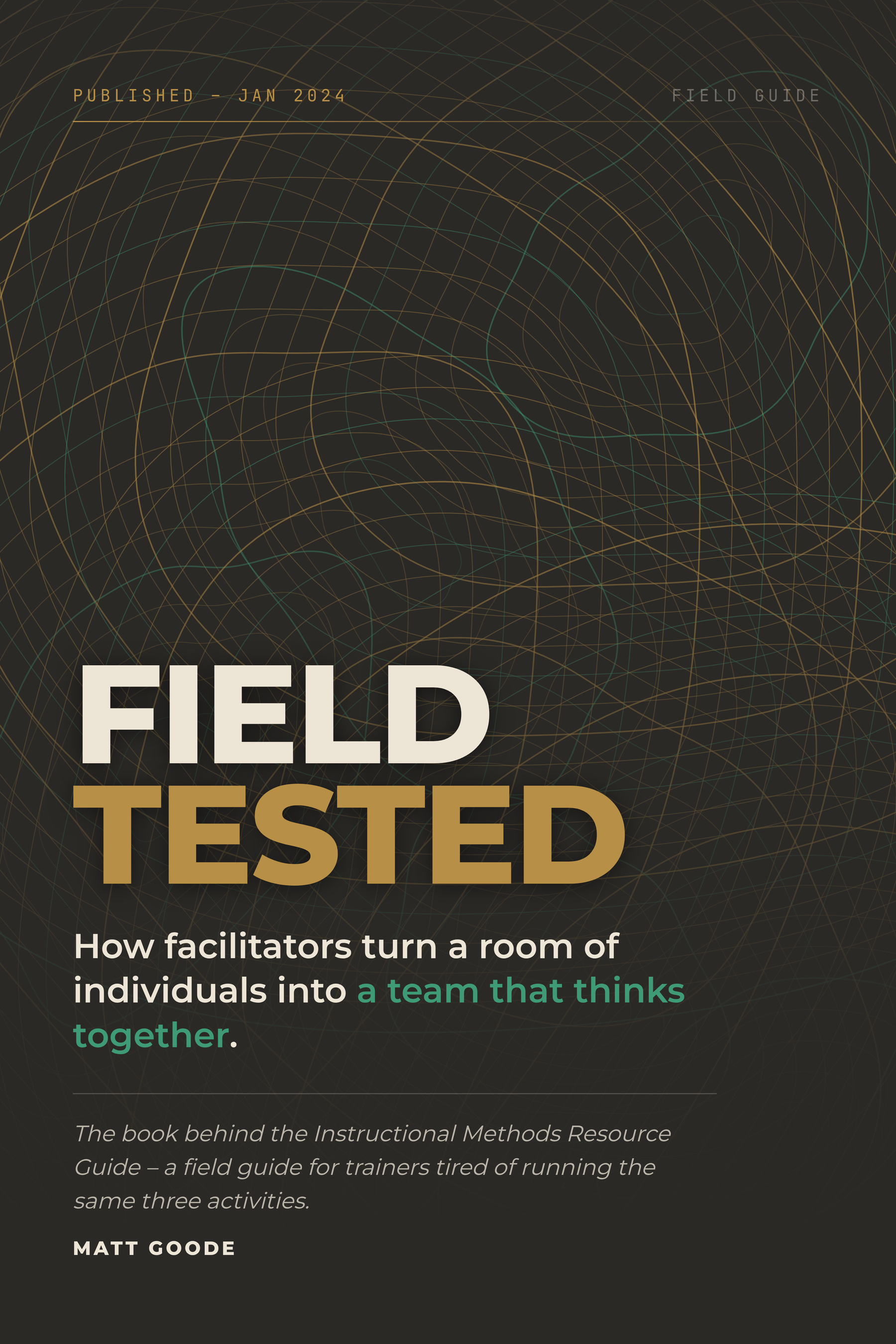
Field Tested
The design system behind the Instructional Methods Resource Guide.
70 methods for setting goals, solving problems, generating ideas, and making calls under pressure – organized by what you're trying to do in the room, not by theory.
About the Book
This is a working reference, not a narrative – 70 methods for setting goals, solving problems, generating ideas, and making calls under pressure, organized by what you're trying to do in the room. It follows the facilitator: the person running a disaster-response briefing, a refugee-coordination working group, or a Monday team meeting, who has forty-five minutes to get somewhere real. Every method is anchored to an actual session – an NGO capacity-building workshop, a corporate leadership offsite, a community health planning meeting – so the guidance reads like a debrief, not a lecture.
Less like reading a book, more like working from a binder someone already broke in.
Most facilitation guides give you the exercise and stop. This one adds what the exercise actually requires: a neurodiversity note on every method, a virtual-format adaptation, a "works well when / watch out for" panel, and, when the room has to land on a decision rather than just generate ideas, the 6C Decision Compass for naming how that call gets made. It's built from fieldwork across humanitarian and corporate settings, not a single industry's playbook dressed up as universal.
You'll flip to the method you need, get the purpose, the steps, what tends to go wrong, and a real example, then go run the session. It's dense and procedural by design – nothing here is trying to move you, only to get you ready.
Same instinct as Liberating Structures or Gamestorming – but with full facilitator guidance, timing, and tech notes per method, drawn from higher-stakes fieldwork.

A Note from the Author
Every facilitator, trainer, or learning designer has hit this wall: you know the outcome you need, but you're not sure which method will get you there. Brainstorm or structured ideation? Reflection activity or feedback loop? Something visual, or something analytical?
This guide brings together 70 field-tested facilitation and instructional methods – built and refined in real training rooms, workshops, and strategy sessions – and organizes them so you can find the right one at the right moment, with enough practical detail to run it with confidence the first time.
Who it's for
This guide is for anyone whose job involves designing or facilitating learning experiences for groups:
- Trainers and facilitators running workshops or learning events
- L&D professionals designing programs for teams and organizations
- Humanitarian and nonprofit practitioners leading capacity-building or coordination sessions
- Coaches and managers running team meetings, retrospectives, or planning sessions
- Educators and instructional designers adapting methods for classroom or blended learning